
HIPEC Surgery in India: Cost, Eligibility & Recovery
Being told that your cancer has spread to the peritoneum, the thin lining inside your abdomen, can leave you with a lot of questions. You may already be thinking about your treatment options, what comes next and whether surgery can help control the disease.
If your doctor has mentioned HIPEC surgery, you may have come across several unfamiliar medical terms. HIPEC stands for Hyperthermic Intraperitoneal Chemotherapy. In simple terms, it combines surgery to remove visible cancer with heated chemotherapy delivered directly into your abdominal cavity.
But knowing what HIPEC stands for is only the beginning. You may be wondering: Am I eligible for HIPEC? How does the surgery work? How much does HIPEC surgery cost in India? What will recovery be like? And what risks should I know about?
The answers are not the same for everyone. Your eligibility depends on factors such as the type of cancer you have, how extensively it has spread within the abdomen, whether the visible disease can be removed safely and your overall health.
In this blog, we’ll walk through what you need to know about HIPEC surgery in India, from how the treatment works and who may be considered for it to its cost, preparation, recovery and possible risks.
What Exactly Is HIPEC Surgery?
If you have been advised to explore HIPEC, it is useful to understand that HIPEC is not chemotherapy alone.
CRS and HIPEC are two parts of the same treatment approach. CRS is the surgery performed to remove visible cancer from the abdomen, while HIPEC involves circulating heated chemotherapy inside the abdominal cavity to target microscopic cancer cells that may remain after surgery.
The treatment usually involves two stages. First, your surgeon performs cytoreductive surgery (CRS) to remove visible tumour deposits from your abdominal cavity. Once as much visible cancer as possible has been safely removed, heated chemotherapy is circulated directly inside the abdomen.
The aim is to treat microscopic cancer cells that may remain after surgery.
HIPEC may be considered for selected cases of appendix cancer, colorectal cancer, ovarian cancer, primary peritoneal cancers and certain other abdominal cancers.
Whether you may benefit from HIPEC depends on the nature and extent of your cancer. Simply having cancer that has spread to the peritoneum does not automatically mean that HIPEC is the right treatment for you.
How Do Doctors Decide If HIPEC Is Right for You?
If you are wondering whether you are eligible for HIPEC, no single test can answer the question.
Your medical team will review several aspects of your cancer and overall health.
First, they will consider what type of cancer you have and how it behaves. HIPEC is used selectively because its potential benefits vary between different cancers.
They will also assess how much cancer is present inside your abdomen and where it is located. CT or MRI scans can provide important information, while some patients may need further evaluation.
Your doctor may also discuss the Peritoneal Cancer Index (PCI). This is used to describe the extent and distribution of cancer within the peritoneal cavity and can help the surgical team assess whether adequate cytoreduction may be possible.
Your overall health matters too. Your kidney and liver function, heart and lung health, nutritional status and general fitness may all be assessed before surgery.
As Dr. Archit Pandit explains, “HIPEC is not a treatment that can be recommended simply because cancer has spread to the abdomen. We first need to understand the type of cancer, how extensively it has spread and whether the visible disease can be removed safely. Careful patient selection is one of the most important parts of achieving the best possible treatment outcome for the individual patient.”
This is why two people with seemingly similar diagnoses may receive different treatment recommendations.
What Does HIPEC Surgery Cost in India?
If you are researching HIPEC surgery in India, cost is likely to be one of the first practical questions on your mind.
There is no fixed price for HIPEC because the treatment can vary considerably from one patient to another. The extent of cytoreductive surgery, additional procedures and length of hospitalisation can all affect the final bill.
Broad published estimates may range from approximately ₹4.5 lakh to ₹15 lakh or more. However, this is only an indicative range and should not be taken as a standard price for every patient.
Your HIPEC surgery cost in India may depend on:
- The type and extent of your cancer
- The amount and location of peritoneal disease
- The complexity of cytoreductive surgery
- The chemotherapy drug used
- Additional procedures required
- ICU and hospital stay
- Preoperative investigations
- Postoperative medicines and care
- Management of complications
- Follow-up investigations and treatment
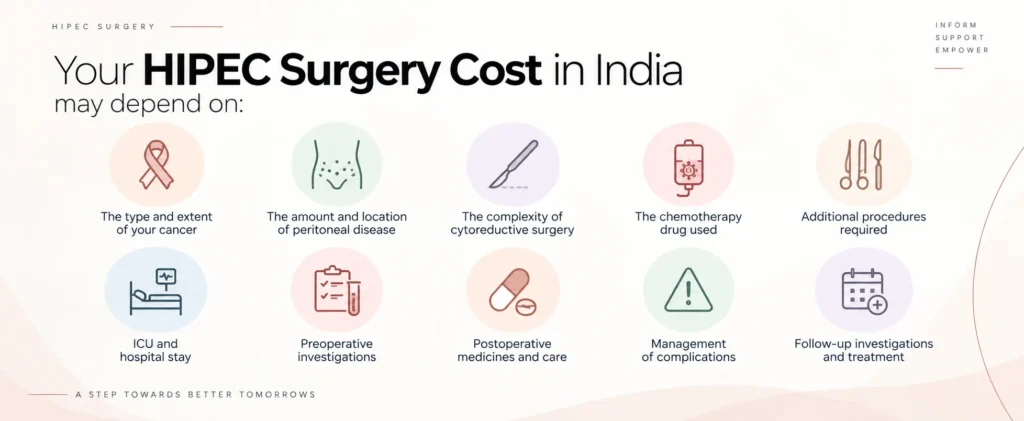
When you receive a cost estimate, ask what it includes. Hospitalisation, chemotherapy, ICU care, investigations and postoperative treatment can all influence your overall expenses.
As Dr. Pandit explains, “When patients consider HIPEC, cost is understandably an important concern, but it should not be the only consideration. The complexity of surgery, experience of the treating team and quality of postoperative care can all influence the treatment journey. Every patient needs an individual treatment plan based on their cancer and overall health.”
What Should You Expect Before HIPEC Surgery?
Your preparation for HIPEC begins well before you enter the operating room.
Your doctor will review your biopsy and pathology reports, imaging scans, previous cancer treatments and medical history. These details help the team understand your disease and decide whether cytoreductive surgery is feasible.
You may also undergo tests to assess your fitness for major surgery. These can include blood tests, kidney and liver function tests, nutritional assessment and other health evaluations.
If you have anaemia, nutritional deficiencies or another medical problem that could affect surgery, your medical team may address these beforehand.
You will also receive instructions about your regular medicines, eating and drinking before surgery and bowel preparation if required.
Although this preparation can feel extensive, it is an important part of making the treatment as safe and well-planned as possible.
What Happens During the Procedure?
The exact procedure depends on your cancer and how it has spread.
During the first stage, your surgeon examines the abdominal cavity and removes visible tumour deposits wherever this can be done safely. This is the cytoreductive surgery component.
Once the visible cancer has been addressed, the HIPEC phase begins. A heated chemotherapy solution is introduced into your abdominal cavity and circulated for a defined period.
The chemotherapy comes into direct contact with the abdominal surfaces to treat microscopic cancer cells that may remain after surgery.
Once the treatment is completed, the chemotherapy solution is drained, and the operation is finished.
The chemotherapy drug used, temperature and duration of treatment can vary depending on your cancer and the treatment protocol.
What Can You Expect During Recovery?
Recovery after HIPEC surgery takes time. Since cytoreductive surgery can be extensive, you may need to stay in the hospital for several days or longer.
During the early recovery period, your medical team will monitor your pain, bowel function, nutrition, hydration, kidney function, blood tests and wound healing.
You will generally be encouraged to start moving gradually as your condition allows. Nutrition is also an important part of your recovery following major abdominal surgery.
Once you return home, you may continue to feel tired for some time. Your appetite and digestion may also take a while to return to normal.
Your recovery will depend on the extent of your surgery, your general health and whether you experience any complications. Follow-up appointments are important for monitoring your progress and discussing any further cancer treatment you may need.
What Risks Should You Know About?
Like any major cancer surgery, HIPEC carries potential risks.
You may experience complications such as:
- Bleeding
- Infection
- Blood clots
- Delayed bowel function
- Bowel obstruction
- Leakage after bowel surgery
- Changes in blood counts
- Kidney-related complications
- Nutritional problems
- Chemotherapy-related side effects
- Wound complications
- Cancer recurrence
Your individual risk depends on factors such as your overall health, type and extent of cancer, complexity of surgery and chemotherapy used.
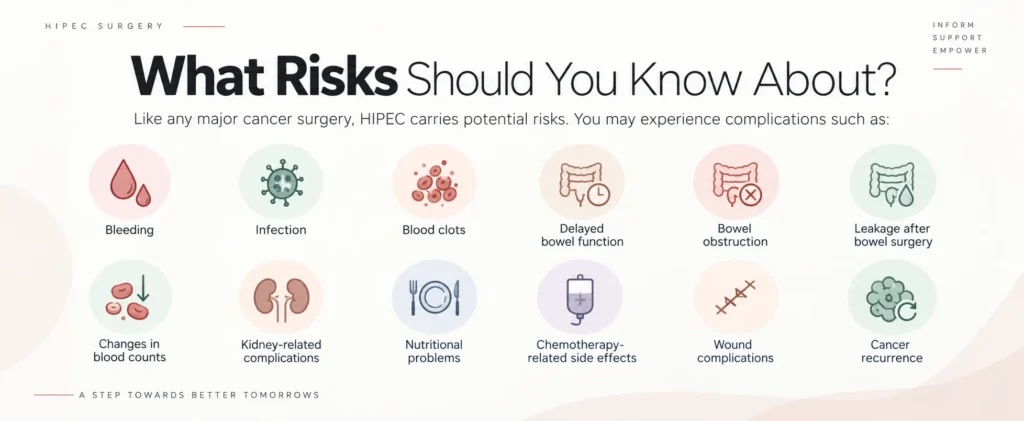
Understanding these risks before treatment can help you have a realistic discussion with your medical team about whether the potential benefits of HIPEC outweigh its risks in your particular situation.
Why Does the HIPEC Treatment Team Matter?
HIPEC involves much more than administering chemotherapy. It brings together complex abdominal surgery, chemotherapy, anaesthesia and postoperative care.
Your treatment therefore requires careful planning and coordination. An experienced HIPEC surgeon in India can assess the distribution of your peritoneal disease and determine whether adequate tumour removal is possible.
You may also be cared for by a wider multidisciplinary team that includes surgical oncology, medical oncology, radiology, anaesthesia, critical care and nutrition specialists.
When comparing options for HIPEC treatment in India, it is therefore worth looking beyond the quoted cost and considering the experience of the team and the level of care available before, during and after surgery.
What Should You Ask Your Doctor Before Deciding?
If HIPEC has been suggested for you, it is completely reasonable to have questions.
You may want to ask:
- What type of cancer do I have?
- How extensively has it spread within my abdomen?
- What is my PCI score, if applicable?
- Can the visible cancer be removed safely?
- Why is HIPEC being recommended in my case?
- What benefits can I realistically expect?
- What are the major risks?
- How long might I need to stay in hospital?
- What will my treatment cost include?
- Will I need additional cancer treatment afterwards?
Having this conversation can help you understand where HIPEC fits into your overall treatment plan rather than viewing the procedure or its cost in isolation.
The Bottom Line
If you are exploring HIPEC surgery in India, it is important to remember that this treatment is not suitable for every patient with peritoneal cancer.
Your cancer type, the extent of disease, whether the visible tumour can be removed safely, and your overall health all play a role in the decision.
The cost of HIPEC surgery in India can also vary significantly depending on the complexity of surgery, chemotherapy, hospital stay and postoperative care.
If HIPEC has been recommended for you, take the time to understand why it has been suggested, what the treatment involves, what recovery may look like and what risks you should consider. A clear conversation with your cancer care team can help you make a decision that is appropriate for your individual situation.
This article is intended for general educational purposes and should not be considered a substitute for medical advice. Treatment decisions should be made in consultation with a qualified cancer specialist based on your diagnosis, investigations and overall health.

 WhatsApp